Services Alt
Welcome to Building Principles
Is Your Business Protected From An Ada Lawsuit?

ADA Restroom Requirements 2026 (Dimensions + Clearances Guide)

CASp Inspection & ADA Compliance Services

Building Principles will get you the peace of mind of being ADA compliant, call one of our Certified Access Specialists today. Call or text us to set up your free consultation

ADA Restroom Requirements 2026 (Dimensions + Clearances Guide)

Blog: ADA Restroom Requirements 2026 (Dimensions + Clearances Guide)
February 19, 2026 |

Restrooms: A High-Risk Compliance Area

Restrooms remain one of the most frequently cited areas in ADA inspections and Title III lawsuits. Even minor measurement errors—an inch too narrow, a grab bar slightly misaligned, a mirror mounted too high—can create access barriers and legal exposure. As we move into 2026, business owners must ensure restroom layouts meet current ADA and California CBC 11B standards. This guide outlines the critical dimensions, clearances, and fixture requirements you need to verify for compliant and functional restroom design.
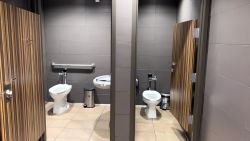
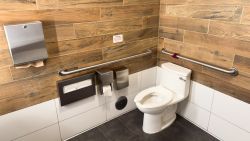
Accessible Stall Dimensions & Layout Requirements

Accessible toilet compartments must provide sufficient maneuvering space for wheelchair users. Standard wheelchair-accessible stalls generally require a minimum 60-inch width and either a 56-inch depth (wall-mounted toilet) or 59-inch depth (floor-mounted toilet). Doors must provide proper maneuvering clearance and cannot swing into required clear floor space unless specific conditions are met. The toilet centerline must be positioned 16–18 inches from the adjacent side wall. Accurate field measurements are critical, as stall depth, width, and door placement are common compliance deficiencies.

Blog: Element #1

Grab Bar Placement & Mounting Heights

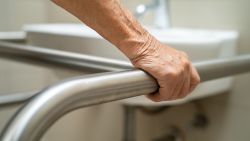
Grab bars must be securely installed on the rear and side walls of accessible stalls. The side wall grab bar is typically 42 inches long minimum and positioned 12 inches maximum from the rear wall. The rear wall grab bar must be at least 36 inches long. Both must be mounted 33–36 inches above the finished floor to the top of the gripping surface. Improper anchoring, incorrect heights, or missing extensions are frequent violations that can compromise both safety and compliance.

Blog: Element #2

Lavatory Heights, Knee Clearance & Clear Floor Space

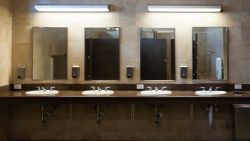
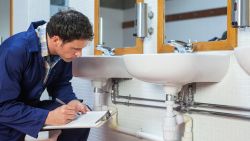
Accessible lavatories must be mounted with a maximum rim or counter height of 34 inches above the finished floor. Adequate knee and toe clearance is required below—typically 27 inches minimum knee clearance height and 30 inches minimum width. A clear floor space of at least 30 by 48 inches must be provided for forward approach. Pipes must be insulated or otherwise configured to prevent contact hazards. Encroachments into required clear floor space, especially from trash bins or cabinetry, are common inspection findings.

Blog: Element #3

Mirrors, Dispensers & Reach Ranges

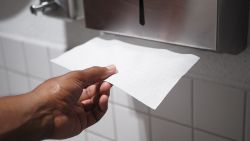
Accessories inside the restroom must also meet reach range requirements. Mirrors above lavatories must have the bottom edge of the reflecting surface no higher than 40 inches above the finished floor. Soap dispensers, paper towel dispensers, and hand dryers must generally fall within accessible reach ranges—typically 15 to 48 inches above the floor for forward or side reach, depending on depth and obstruction conditions. Items mounted too high or placed outside accessible clear floor space can render an otherwise compliant restroom deficient.

Blog: Element #4

Maneuvering Clearances & Door Requirements

Restroom entry doors must provide required maneuvering clearances on both push and pull sides. Door hardware must be operable with one hand and without tight grasping, pinching, or twisting of the wrist. Opening force limits must also be observed. Inside the restroom, required turning space—either a 60-inch diameter circle or T-shaped turning space—must remain unobstructed. Storage, baby changing stations, and temporary items cannot reduce required turning clearances. Regular field verification helps prevent operational regressions.

Blog: Element #5
Share This Article:
Mission Statement

We as a society are morally obligated to provide proper accessibility for the disabled. At Building Principles, we believe that most business owners have every intention of making their business fully accessible. Our CASp Inspectors aim to help those business owners with the best intentions provide an accessible place to purchase goods and services for everyone. By creating an accessible environment, you send a message to the almost 26% of Americans living with disabilities that you care and can positively affect your business.

If you are looking to get your business ADA compliant and want protection from costly ADA lawsuits. Don't hesitate and give us a call or contact us at the link below to get a quote for your business, and see how we can get your business accessible and protected today.

More Blogs Contact Us
 Contact Building Principles

Get Your Business ADA Compliant Today!

JASON JAMES; CASP-479,DSA CLASS 1(4703)
CALIFORNIA COMMERCIAL BUILDING INSPECTOR
Service Areas our main service areas but not limited to these locations